
Lighting Manufacturer for Custom Neon
Neonita manufactures individual illuminated signs for businesses, designers and private clients, combining design preparation with LED neon or traditional glass neon production.
The phrase lighting manufacturer covers a wide field, so our scope is important: Neonita specialises in made-to-order neon signs and illuminated features. We do not manufacture general architectural lighting ranges, and we do not sell loose transformers, glass tubes or installation components as retail products. We select those materials as parts of a complete sign designed around approved artwork and a known operating environment.
A project may begin with a company logo, wording, illustration, wall photograph or early sketch. We consider the intended size, line complexity, viewing distance, colours, backing, power and mounting before recommending a production direction. LED neon and hand-bent glass neon can both create distinctive light, but their construction, handling and visual character differ. Manufacturing begins only after those differences have been translated into a clear sign specification.
Neonita has worked in Vilnius since 2008. The accumulated experience is expressed through a practical sequence rather than unsupported promises: clarify the brief, prepare and approve the visual, manufacture the sign, assemble the necessary electrical elements, test the completed work and then arrange the agreed delivery or installation step.
Learn how our workshop and local project planning support neon signs in Vilnius for commercial and private settings.
Before manufacture, coordinate the site requirements for neon sign installation in Vilnius.
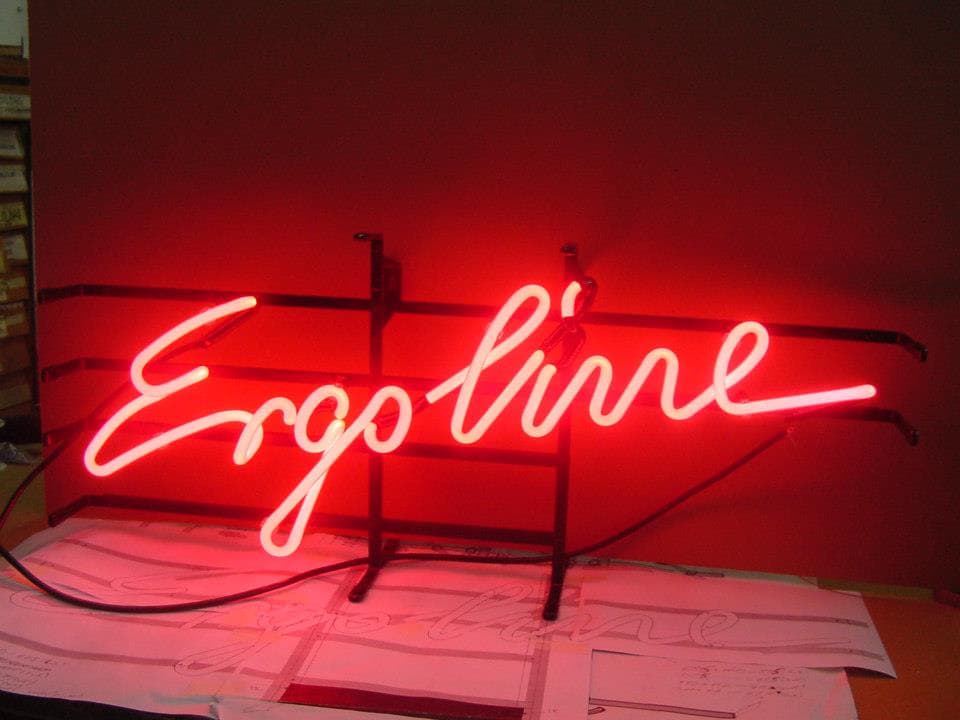
Manufacturing starts with definition
The sign is resolved on paper before materials are shaped
An illuminated logo is not simply a printed image with light added. Line width, gaps between elements, letter connections and overall scale determine whether the artwork can be produced cleanly and remain readable. A wall that looks generous in a close photograph may feel much smaller from the room entrance. We therefore ask for approximate dimensions, a straight-on location image and the normal viewing distance alongside the artwork.
The intended environment affects manufacturing choices too. Indoor, sheltered and exposed positions do not use identical specifications. The wall material and desired cable route influence the backing and fixing plan. A sign that may be moved for events needs a different handling approach from a permanent reception logo. Resolving those questions before production reduces the risk that the finished object and its location will conflict.
The customer reviews the exact wording, correct logo version, dimensions, proportions, colour direction and planned cable position. Where artwork contains lines that are too fine, extremely tight corners or small gaps, we explain the need for adaptation. The goal is to protect the identity of the idea while giving the chosen manufacturing method enough physical clarity to work.
Modern illuminated profiles
How custom LED neon is planned as a complete sign
LED neon commonly places flexible lighting inside a diffusing profile and arranges it on an acrylic backing. This construction supports text, logos, symbols and decorative outlines, including multicolour compositions where the design allows. The backing can be transparent, coloured, rectangular or cut closer to the illuminated form. It provides structure and influences the visual weight of the finished piece.
Available LED colours give designers a broad range of directions, but illuminated light should not be treated as an exact copy of a printed swatch or screen. Wall colour, daylight and surrounding fixtures all change perception. When a brand colour is critical, the discussion should focus on the available illuminated result. The current configurator also shows a remote-control option whose compatibility and function are confirmed for the individual project.
Electrical components, cable positions, controls and mounting parts are specified with the sign. A lightweight construction may simplify some interior installations, but the surface, access and exposure still require attention. An LED sign intended for a dry wall indoors cannot automatically be moved to an exposed outdoor location. Manufacturing follows the declared use rather than a generic label.
- Lettering, logo outlines, icons and decorative line work
- Transparent or glossy-white backing, rectangular or cut closer to the design
- Single-colour or multicolour directions where practical
- A compatible remote-control option where confirmed for the project
Traditional specialist craft
Glass neon is shaped by hand over a production pattern
Traditional glass neon begins with artwork adapted to the behaviour of tubing. Once the composition and dimensions are approved, we prepare a full-size production pattern. A skilled glassblower heats each tube and bends it to follow that pattern. Curves, returns and connections are formed as physical glasswork, giving the finished sign the character of an authentic shaped tube rather than a flexible imitation.
Electrodes are fitted to the tubes, which are then processed and filled with neon or an argon-based gas mixture. The gas and any tube coating contribute to the final colour. The sign also needs a suitable electrical arrangement, tube supports, high-voltage cable and mounting components. These elements are selected for the complete project and are not offered as separate retail goods.
Neonita uses proven production materials where appropriate, including glass tubes from Tecnolux, Glostertube and other manufacturers, SIET and F.A.R.T. high-voltage transformers, and Tecnoservice, Hansen or other suitable electronic power solutions. Naming a manufacturer does not mean that every component belongs in every sign. Selection depends on the technical requirements of the individual design.
Before the sign leaves the workshop
Assembly and testing are part of production
A finished-looking sign is not complete until its connections and operation have been checked. Traditional glass neon is placed on a test stand after the tubes, electrodes and electrical system have been assembled. We inspect brightness, connections and stable operation. For LED projects, the planned lighting, power and control arrangement is reviewed as part of preparing the complete sign for handover.
Testing does not replace correct site preparation. The customer or project team still needs to provide accurate wall, power and access information, and installation responsibilities must be agreed for the specific project. The workshop check establishes that the produced sign is ready for the planned next step; it cannot compensate for an unsuitable circuit, unprepared wall or changed location.
After final inspection, the sign is packed for the agreed delivery method or prepared for the arranged installation. Portable and fragile work needs handling appropriate to its backing and construction. Traditional glass in particular should be treated as specialist material. Any future relocation should be discussed before production if it is an important requirement.
Production follows the setting
Manufacturing for hospitality, retail, offices and interiors
Commercial spaces use illuminated signs for several distinct reasons. A café or bar may want atmosphere and a memorable photography point. A shop may need immediate recognition from the entrance or through a window. An office reception may prioritise accurate logo proportions and clean cable management. Event features may need backing and connection choices that support transport and repeated setup.
Private clients often begin with a name, phrase, date or illustration. These signs are still manufactured around real dimensions, wall conditions and viewing angles. A personal design benefits from the same artwork approval and electrical planning as a company sign. The difference lies in purpose and visual tone, not in skipping the practical steps.
For exterior advertising or other exposed positions, the location must be identified from the start. Weather, access, mounting and permissions may affect the available solution. We do not state that one construction suits every outside setting. The manufacturing recommendation follows the specific environment described in the enquiry.
A better brief supports better production
What the manufacturer needs to know
Send the final wording or preferred logo file, a location photograph, approximate finished dimensions and the date by which the sign is needed. Add the wall material, nearest power point and whether the position is indoor, sheltered or exposed. If the project forms part of a wider fit-out, a wall elevation and electrical plan help coordinate the sign with other trades.
You can contact Neonita before every detail is available. An early conversation can identify which measurements and files will be needed. A final quotation and production approval, however, should be based on an agreed design and practical installation information rather than assumptions about size or location.
- Approved wording, logo or illustration
- Proposed width, height and viewing distance
- Wall photograph, material and mounting information
- Electrical point, cable direction and control requirements
- Indoor, sheltered or exposed operating conditions
- Required date, delivery needs and installation responsibility
Clear expectations
Manufacturing questions answered by the project brief
Cost depends on the approved design, dimensions, line complexity, colours, backing, electrical elements, controls, environmental protection, mounting and delivery. There is no responsible universal price based only on the word “neon.” A location photograph and dimensions allow the quote to reflect the intended object and its setting.
Production timing includes design review, any revisions, manufacturing, assembly, testing and delivery. A fixed opening, event or installation date should be shared at the first contact. The method and schedule can then be discussed honestly for the individual project without publishing an unsupported standard lead time.
Areas We Serve
Neonita manufactures custom neon signs in its Vilnius workshop and presents Vilnius as the confirmed local service area. Business owners, designers and private clients can use the location to discuss artwork, intended placement and production options. Projects connected with another city should provide their exact delivery and installation conditions for an individual assessment.
Explore custom neon manufacturing in VilniusFrom approved artwork to tested light
Plan a custom neon sign with our Vilnius workshop
Share the artwork, intended dimensions and a photograph of the location. We will help define the production method and the information required before the sign can be manufactured.
Contact us